Choosing between pergola styles usually comes down to one practical question: how much control do you want over sunlight, shade, and airflow as the day changes? A tiltable pergola uses adjustable louvers that rotate to let in exactly as much sun as you like, while a fixed-roof pergola gives you constant, unchanging shade with far fewer moving parts. Both works well in Dubai — they just solve the comfort problem in different ways. Here’s how they actually compare.
Table of Contents
How a Tiltable Pergola Works
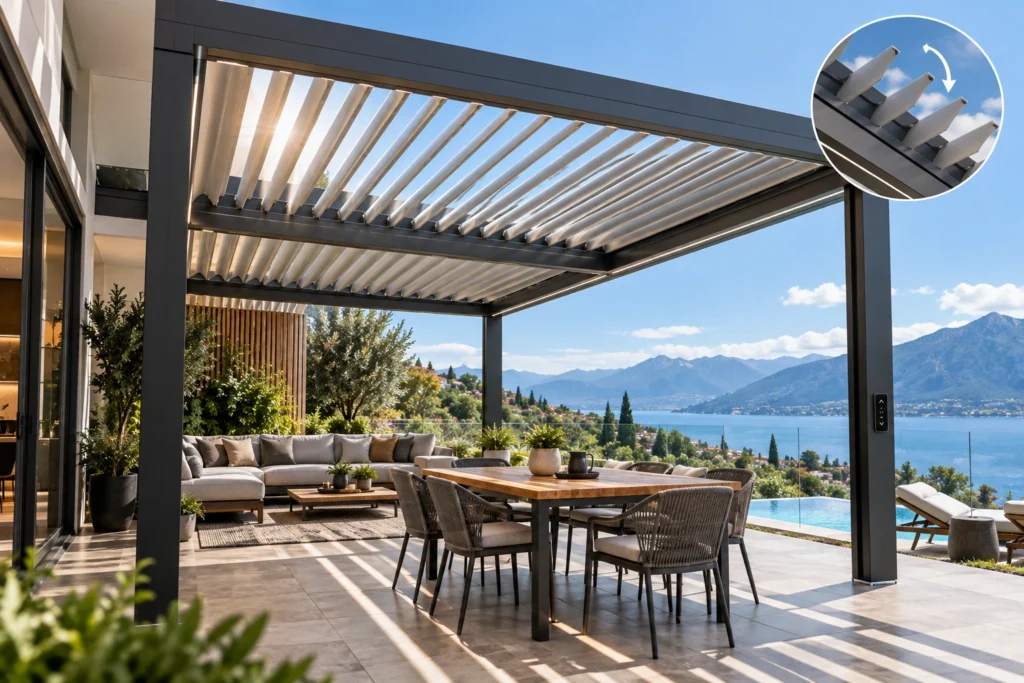
A tiltable pergola is built around a set of aluminum louvers, or blades, that rotate on a shared axis — either by a motor and remote or, in simpler versions, a manual lever. Turning the louvers changes how much direct sun, shade, or open sky comes through, so the same structure can go from fully open to fully closed depending on the time of day or the weather.
How a Fixed-Roof Pergola Works
A fixed-roof pergola has a permanent roof — solid, slatted, or a fixed lattice — that doesn’t move. What you see when it’s installed is what you get every day after. There’s no motor, no remote, and far fewer parts that can eventually wear out or need servicing.
Comfort and Climate Control
This is where the two styles diverge the most. A tiltable pergola lets you open the louvers on a mild evening to enjoy the breeze, then close them tight during peak midday sun — useful across Dubai’s wide swing between scorching afternoons and pleasant winter evenings. A fixed-roof pergola offers constant shade but no flexibility: a fully solid roof can trap heat underneath if it isn’t paired with good ventilation, while an open-lattice fixed roof gives only partial shade with no way to close the gaps when the sun is at its harshest.
Airflow matters just as much as shade in Dubai’s humidity. Because a tiltable pergola can angle its louvers rather than sealing the space completely, it allows a cross-breeze to pass through even while blocking direct sun — something a fully solid fixed roof can struggle with unless it’s designed with gaps or fans built in from the start.
Which Spaces Suit Each Style
A villa garden used mostly in the evenings, or a rooftop lounge that hosts guests at different times of day, tends to get more value from a tiltable pergola’s flexibility. A poolside seating area or a straightforward garden shade structure, used mainly for a consistent midday escape from the sun, often does just as well with a fixed roof at a lower cost. Commercial spaces like restaurant terraces sit somewhere in between — many opt for tiltable systems specifically because they extend usable hours across a full-service day, which a fixed roof can’t adjust for.
Maintenance and Long-Term Reliability
A tiltable pergola has more components — motor, hinges, drive tracks — which means more to clean, lubricate, and occasionally service. A fixed-roof pergola, with no moving parts, is close to maintenance-free beyond the usual clean-off of dust and debris. If low upkeep is your priority, the fixed roof has a clear advantage.
Cost Considerations
Because of the motor, controls, and precision-engineered louvers, a tiltable pergola typically costs more upfront than an equivalent fixed-roof structure. A fixed roof is usually the more budget-friendly option for the same footprint, which matters if you’re covering a large area or working to a set budget.
Related blog post – Tiltable Pergola vs Fixed Roof Pergola: Which One Suits Your Dubai Home?
Which One Should You Choose?
The right choice depends less on which one is “better” and more on how you plan to use the space.
- Choose a tiltable pergola if you want daily flexibility, use the space at different times of day, or entertain often in changing weather
- Choose a fixed-roof pergola if you want predictable shade, minimal upkeep, and a lower upfront cost
- For restaurants and commercial spaces with long operating hours, a tiltable pergola often earns back its cost by keeping tables usable through more of the day
- For a straightforward home shade solution over a fixed budget, a fixed roof does the job without the extra complexity
Conclusion
Both a tiltable pergola and a fixed-roof pergola can transform an outdoor space — the difference is really about how much control you want on a day-to-day basis versus how little you want to think about maintenance. Walking through your typical use of the space with a pergola specialist, rather than deciding on looks alone, is usually the fastest way to land on the right one.